Wednesday, December 5, 2012


Monday, December 3, 2012
CPD Thing 5: Reflective Practice
Reflective practice ( reflecting on the previous 4 Things, and really of all the things I have gotten to do through my blog, techie stuff, and library do-dads), has allowed me to...
- Realize how I can make better use of my time online without getting too bogged down
- See more online -- more fun things especially! Google Reader has become my dearest friend
- Appreciate my blog more, and that it's not a waste of time
- Realize that Twitter isn't all dull dribble, but actually can be nice
- Realize that there are some things I should try, but that I still don't need to stretch too thin
- Remind myself that there is always more to learn and more to do -- get sponging!
Sunday, November 18, 2012
CPD Thing 4: Twitter, RSS, and Storify
Thing 4 in the 23 Things for Professional Development is about current awareness and staying up to date in library trends and other things that you like by using various technologies to make it a little easier. The three technologies this Thing has us looking at is Twitter, RSS Feeds, and Storify.
Twitter
I really haven't gotten into using Twitter. I already had a Twitter account at https://twitter.com/Spnge4Knowledge , but I for some reason got it in my head that I should use it to promote my own blog rather than using it to keep up with what's going on in the library world in general. Like the 23 Things blog said, I mainly thought of it as celebrities tweeting about what they ate for lunch, and on occasion, I've used it to see how ridiculous (and completely uninteresting) people can be which they feel they need to publicize. In fact, when I'm feeling down, I like to search for #YOLO because it always makes me laugh out loud. Seriously though, give that a shot... https://twitter.com/search?q=%23yolo&src=typd
Meanwhile, I also decided that I should only follow as many people as were following me, and therefore, I follow a puny amount of accounts, and I've been missing out on a lot of great chances to keep up with bigger fish. So the first thing I did was to look up VLA (Virginia Library Assn) and follow them. Then, I proceeded to look at who they follow, and went from there. I've now doubled the number of accounts that I follow, but they will hopefully be useful to me. Also, if you're looking for a job in libraries, there are a lot of organizations you can follow that post job information, which I've found to be helpful in the job search.
One of my favorite things to follow is EarlyWord, which abounds in awesome information about new books and movies that can help me get a leg up on what's coming up next. Having already been checking into the website off and on, I'm now following the Twitter account and have added it to my Google Reader-- see below.
RSS Feeds
I knew that this was an important tool, but somehow thought it to be more complicated than it really was (this is hilarious to me, since RSS stands for "Really Simple Syndication"), and was embarrassed that I didn't already know how to use it. However, I didn't actually realize that I had already started to use RSS feeds -- I "subscribed" to various blogs but only checked them through Blogger, rather than using Google Reader to just quickly browse the various new posts on blogs in this easy-to-use format. Not really sure why, but now that I've got the hang of it, it's awesome, and get this -- really simple. Especially because before now I wasn't quite sure how to follow blogs outside of the Google-sphere. Now I can follow everything, all in one spot, and quickly see what new posts might be worth checking out! Lovely.
Storify
For me, Storify is just a step too far, and I'm not sure that I need to make different "stories" out of all the other social media content that exists out on the web. I like sharing different blogs and things, but I would rather just share it on my blog, where I can also weigh in on what I'm sharing a little more. So I'm skipping this one. Just because it is there doesn't mean it's right for me.
I really haven't gotten into using Twitter. I already had a Twitter account at https://twitter.com/Spnge4Knowledge , but I for some reason got it in my head that I should use it to promote my own blog rather than using it to keep up with what's going on in the library world in general. Like the 23 Things blog said, I mainly thought of it as celebrities tweeting about what they ate for lunch, and on occasion, I've used it to see how ridiculous (and completely uninteresting) people can be which they feel they need to publicize. In fact, when I'm feeling down, I like to search for #YOLO because it always makes me laugh out loud. Seriously though, give that a shot... https://twitter.com/search?q=%23yolo&src=typd
Meanwhile, I also decided that I should only follow as many people as were following me, and therefore, I follow a puny amount of accounts, and I've been missing out on a lot of great chances to keep up with bigger fish. So the first thing I did was to look up VLA (Virginia Library Assn) and follow them. Then, I proceeded to look at who they follow, and went from there. I've now doubled the number of accounts that I follow, but they will hopefully be useful to me. Also, if you're looking for a job in libraries, there are a lot of organizations you can follow that post job information, which I've found to be helpful in the job search.
One of my favorite things to follow is EarlyWord, which abounds in awesome information about new books and movies that can help me get a leg up on what's coming up next. Having already been checking into the website off and on, I'm now following the Twitter account and have added it to my Google Reader-- see below.
RSS Feeds
I knew that this was an important tool, but somehow thought it to be more complicated than it really was (this is hilarious to me, since RSS stands for "Really Simple Syndication"), and was embarrassed that I didn't already know how to use it. However, I didn't actually realize that I had already started to use RSS feeds -- I "subscribed" to various blogs but only checked them through Blogger, rather than using Google Reader to just quickly browse the various new posts on blogs in this easy-to-use format. Not really sure why, but now that I've got the hang of it, it's awesome, and get this -- really simple. Especially because before now I wasn't quite sure how to follow blogs outside of the Google-sphere. Now I can follow everything, all in one spot, and quickly see what new posts might be worth checking out! Lovely.
Storify
For me, Storify is just a step too far, and I'm not sure that I need to make different "stories" out of all the other social media content that exists out on the web. I like sharing different blogs and things, but I would rather just share it on my blog, where I can also weigh in on what I'm sharing a little more. So I'm skipping this one. Just because it is there doesn't mean it's right for me.
Wednesday, October 31, 2012
Spongy Changes
A lot has changed in my little world these past few weeks -- I am now working as a Children's Specialist at the Gordon Avenue Library to indulge my love of children's literature, reading stories aloud, and to try my hand at some programming. I do preschool and drop-in storytimes, afterschool programs every other week for elementary-school aged kids, and children's programming. So. There's a lot to think about there. On top of that, I am also the Young Adult person here, which is really exciting. I'll be planning programs, but also trying to build up the teen programs here at Gordon Ave. and hope to come up with some really exciting ways to engage them in the library.
Having started fully in September, I have gotten a feel for what I'm doing a little better now after two months into it, and I am ready to start sharing. Hoorah!
In addition, if it's escaped previous attentions, I'm putting my recipes and adventures in food into the tab marked "In the Kitchen", a slightly different blog with my food stuffs on it-- especially useful for searching for my own recipes when I want to find one quickly, use the iPad as my recipe book, or share one with friends. Have at it!
Having started fully in September, I have gotten a feel for what I'm doing a little better now after two months into it, and I am ready to start sharing. Hoorah!
In addition, if it's escaped previous attentions, I'm putting my recipes and adventures in food into the tab marked "In the Kitchen", a slightly different blog with my food stuffs on it-- especially useful for searching for my own recipes when I want to find one quickly, use the iPad as my recipe book, or share one with friends. Have at it!
Saturday, June 30, 2012
Book Displays on Display!
My book displays now have a place to live of their very own -- see the Book Displays tab at the top of my blog page!
 |
| Novel Destinations |
 |
| Banned Book Week 2011 |
Thursday, June 7, 2012
Children's Author Highlight: Steve Jenkins
For all those parents of children who have a million and one questions about animals, Steve Jenkins is the guy for you. He co-authors many of his books with his wife, Robin Page, and he does the illustrations.
 |
| Image from goodreads.com |
One of the questions children will always ask is, "What do animals eat?"
Anytime a desperate parent is looking for something that will be both informative, and still be interesting to their 3-year-old son or daughter (who let's face it, might have an attention span the size of a Jack Russell), I refer them to a Steve Jenkins book. He writes interesting and colorful picture books, with just the right amount of words written in understandable language, and he satisfies both parents and children alike.
The illustrations from the book are paper collages that he carefully arranges over his sketches. The paper is layered on top of each other. He does a marvelous job of choosing papers that compliment the textures of his subjects. Not only are they eye-popping, but they are so much fun to look at! To see how he writes his books, check out the page on his website about how he makes books.
Many of his books stem from the questions his children ask. Children are the ultimate sponges of knowledge, and with their constant curiosities, you can only imagine that it was easy for their dad to turn each one into a perfectly lovely book. Now, when children ask me pretty much any question about animals, there is a Steve Jenkins book to answer their questions. Here are a few of my favorites:
Wednesday, May 30, 2012
Puerto Plata, Por Favor: The Sponge goes to the Dominican Republic
 |
| Not the DR, but islands sure do look pretty from the sky. |
Tuesday - Travel
We pulled an all-nighter before we drove 2 1/2 hours to D.C. C and I got home from work around 10ish that night and had a 6 o'clock flight the next morning. I was entirely too nervous/anxious/excited to sleep, so I packed and unpacked, and checked and rechecked my bags until there was nothing to do but leave. The good news is, our bags (carry-ons only) were perfectly packed. The bad news is, we learned the hard way that all-nighters before a day of travel sucks, and sucks big. Thinking we would sleep on the plane/at the Miami airport was dumb. So dumb.
 |
| Rainy first night. |
When we finally got to our hotel in Puerto Plata, about and hour and a half later than we were supposed to, it was raining and we flopped into bed until dinner. It was beautiful. Check-in was not a bear like some of the reviews we had read, which had us pleasantly surprised.
Meals were largely uneventful affairs. Food at the buffet wasn't great, but we really didn't eat there that often (breakfast every day, lunch twice, and dinner-- never). We ate at the restaurants most of the time, because we were able to snag reservations to different restaurants each night (tip: go to Guest Services and ask them if there are any leftovers at the start of each day). There are various restaurants at the resort, all pretty good, but they try to be so international that I didn't really feel like we got a feel for Caribbean cuisine, except for when we went to the Dominican restaurant (the only night we got to eat Dominican food for dinner), where I had a pastelon de platanos (described as Dominican lasagna with plantains used in place of noodles). I had a sweet corn pudding for dessert and Chris had some sort of coconut dessert which tasted like the inside of a Mounds Bar.
Thursday - Lounging
 |
| Hello, beaches! |
The next day, we were told we had a special welcome package (which we knew was code for "We're going to try to sell you timeshares for an hour," from reading reviews of the resorts and from the advice of a couple we met along the way). We tried to avoid it, but they wait for you outside of the breakfast buffet so that you have no choice. So we were apprehended and taken to the VIP place. Before the guy could give us the tour and launch into his spiel (but AFTER they gave us complimentary butter-you-up chocolates), I asked if we'd have to pay extra. He tried to skirt this question, but I wasn't having it, and neither was Chris, who jumped in saying that he'd lost his job. When he asked us how we could afford our vacation at all, I told them it was a pity trip gifted to us
Tuesday, May 29, 2012
A Savory Recipe: Rosemary Walnut Chicken with Roasted Vegetables
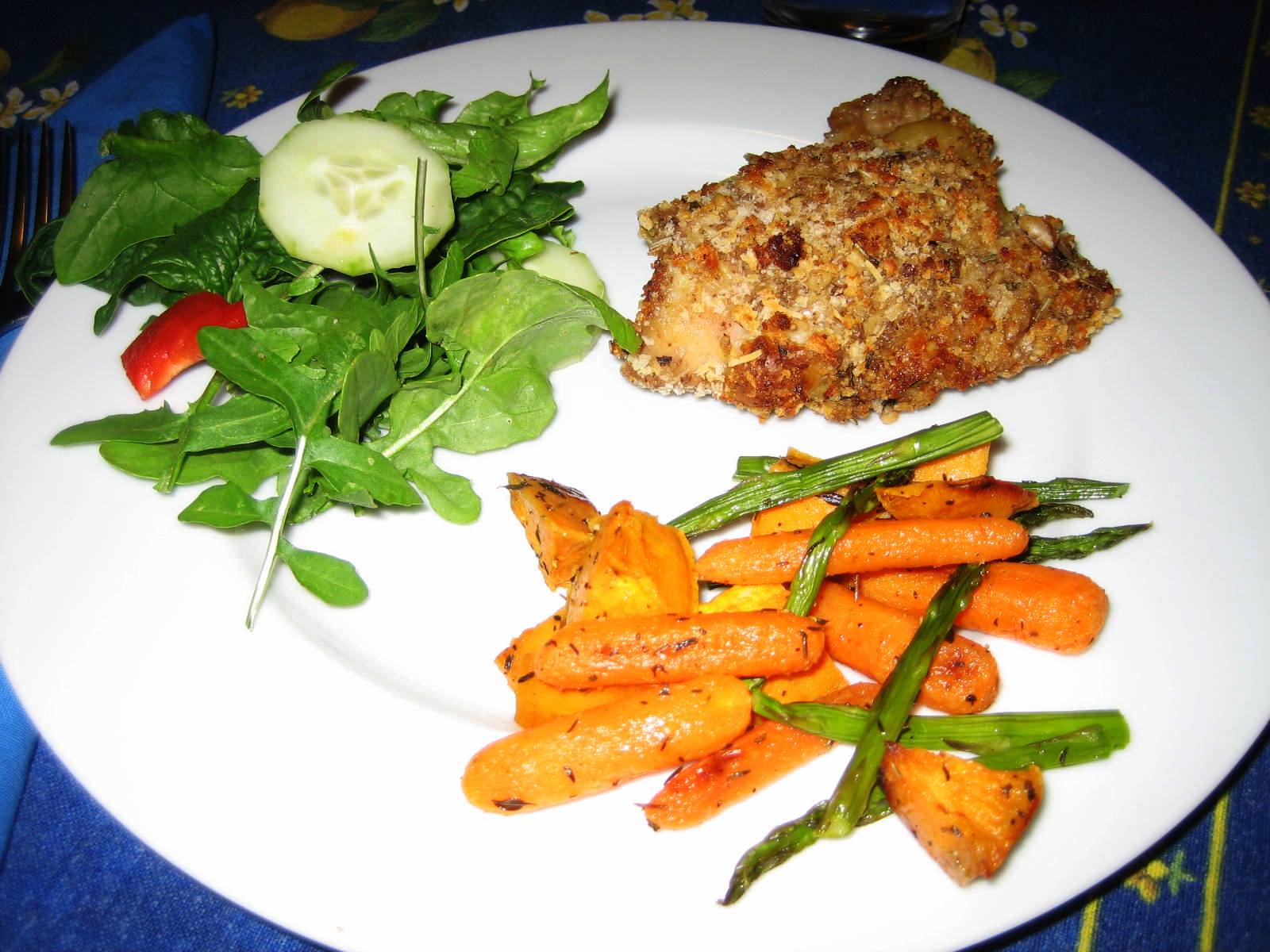 |
| The roasted veggies above consist of asparagus, carrots, and sweet potatoes |
Rosemary Walnut Oven-Fried Chicken
- ¼ c. low-fat buttermilk OR ¼ c. milk with 1 tsp. lemon juice or vinegar(stir thoroughly)
- 2 Tbsp. Dijon mustard
- 4 6-oz. chicken cutlets (or use bone-in chicken, thighs are a good size but other cuts work too)
- 1/3 c. panko (Japanese breadcrumbs) – substitute saltines if no panko
- 1/3 c. finely chopped walnuts (I ground in coffee grinder) and then leave some larger pieces for good texture
- 2 Tbsp. grated Parmigiano-Reggiano cheese
Sunday, May 20, 2012
CPD Things 1, 2, and 3!
Thing 1: Blogs and blogging
So, I've clearly already got the blog down, but this is a nice chance to introduce me to some things, and being the Sponge for Knowledge that I am, I like new Things.
Why I am taking part in this course? Well, as I've stated in Back to Basics, I'm in CPD23 because I didn't get to do much with it last year while I was in school, and now I'm getting my professional development on. Although I feel like I do these kinds of things already, it's a little dash of motivation with a sprinkle of reflection on why I'm doing what I'm doing that makes me like it. I'm looking forward to all of it. This really helped me improve my blog last year, and now I'm getting a chance to push it further. Bring it on!
Thing 2: Investigate some other blogs
It's nice to go around finding new blogs, but the thing I like best about Thing 2 is the commenting. Opening up dialogues between people is the best -- but this is also how I met The Red Headed Traveler during last
So, I've clearly already got the blog down, but this is a nice chance to introduce me to some things, and being the Sponge for Knowledge that I am, I like new Things.
Why I am taking part in this course? Well, as I've stated in Back to Basics, I'm in CPD23 because I didn't get to do much with it last year while I was in school, and now I'm getting my professional development on. Although I feel like I do these kinds of things already, it's a little dash of motivation with a sprinkle of reflection on why I'm doing what I'm doing that makes me like it. I'm looking forward to all of it. This really helped me improve my blog last year, and now I'm getting a chance to push it further. Bring it on!
Thing 2: Investigate some other blogs
It's nice to go around finding new blogs, but the thing I like best about Thing 2 is the commenting. Opening up dialogues between people is the best -- but this is also how I met The Red Headed Traveler during last
Sunday, May 13, 2012
Back to Basics!
Hola friends!
As you know (or may not, if you're new here), I've been working on my Master's degree in Library and Information Science from the University of North Texas. This has taken up quite a bit of time, as you might expect a Master's program to do, leaving me less time for blogging than I'd like. But now, the good news.
I am done! A Master of Information!
What does that mean for this blog?
- More cookerating
- More celebrating
- More free thinking
- More Spanish-learning
- And... more blog writing!
Also, I'll be picking back up on the CPD23 Project, which is now repeating itself for its 2012 edition. For those of you just tuning in, I started this project called the 23 Things for Professional Development last year, which directs librarians to emerging technologies, and introduces them to a great load of, well. Things. For professional development.
I like things, so I joined up last year in a flurry of motivation and excitement for having another thing to do. Or, 23 things, rather. However, I jumped the gun, and because I was in school, couldn't devote as much attention to it as I might have liked. Now that I've graduated, however, this is a perfect way to keep a leg up on social media and emerging technologies.
Tune in next time for my mouthwatering Rosemary-Walnut Chicken and Roasted Vegetables!
Saturday, March 31, 2012
Book Review: 11 Birthdays
A Book Review of:
 |
| Image from GoodReads.com |
11 Birthdays, by Wendy Mass
Summary:
Amanda has not been looking forward to her eleventh birthday ever since she and her best friend Leo (who has the same birthday) stopped talking to each other a year ago at their 10th birthday party. After suffering through it, she wakes up the next morning just to realize that she has to live the day all over again-- school, gymnastics tryouts, and her crummy party!
Review:
I started listening to this as an audiobook, which was very well done, but I checked out the book because I wanted to read more. This book is perfectly written -- from Amanda's point of view, Wendy Mass accurately depicts the feelings of Amanda as she experiences her birthday. From embarrassment, disappointment, and anxiety to her humor, excitement, and pride, Amanda's a very well-rounded character who is extremely believable and likable. Although there is the hint of fantasy (the repeating of a day over and over again), it reads like realistic fiction. It's a great story about friendship and generosity as well, and for anyone who has gone through a rough patch in friendship, it also proves to be a good example
Friday, March 16, 2012
Book Review: Dead Until Dark (Sookie Stackhouse Series, Book 1)

Dead Until Dark by Charlaine Harris
My rating: 4 of 5 stars
After watching True Blood, I wanted to see how the book measured up. Plus, I was in the mood for a book that required a little less thinking. Coming into it from True Blood, I already knew what to expect more or less, and I wasn't let down. It differs from True Blood in terms of characters, but stayed pretty true otherwise. I really liked hearing it on audiobook because the narrator does a good job of characterizing Sookie.
It's good for a light quirky read. It's an easy romance-mystery novel, but she's not your normal amateur detective in that she's not very actively trying to figure out who the murderer is in her hometown, and you get a lot more of overall characterization than you do in Charlaine Harris's Grave Sight series. I'd recommend it if you like quirky paranormal romances with a bit of mystery.
Wednesday, March 14, 2012
Book Review: Rowan Hood: Outlaw Girl of Sherwood Forest
 Rowan Hood: Outlaw Girl of Sherwood Forest by Nancy Springer
My rating: 4 of 5 stars
This is a great book that makes the legendary story of Robin Hood accessible to girls, and lets them experience similar adventures from a girl's point of view. The protagonist is a young girl named Rosemary whose mother is part aelfin, which gave her some magical powers, most especially in the art of healing. Rosemary returns home one day to find her cottage burned down, and herself an orphan. Her mother had always told her that her father was Robin Hood, and so she sets out to find him. She feels alone and tries hard to make it on her own. Along the way to meet her father, she encounters several interesting characters who become her friends. She soon finds that she has inherited unique aspects of her mother and father's characters, and discovers who she is by the end.
This book is a great book for girls to read that will make them feel capable and ready for an adventure. Springer doesn't sugar coat how hard it is living out in the woods for Ro (who disguises herself as a boy named Rowan to protect herself), and she doesn't paint this time period as one that is easy for girls to live in. Nevertheless, Ro is a strong character that girls will find easy to relate to. The author uses some of the language you might expect for the time period, but it doesn't get in the way of reading it.
I would recommend this book to girls who like the Robin Hood tales, who like strong female protagonists, adventure, or books set in the Medieval Period (or stories with knights, kings, princesses, etc).
Nancy Springer is a fun children's author who takes interesting male characters and puts a girl's twist on them. She does this with her Enola Holmes series (Sherlock Holmes's younger sister). If you liked this, try that series as well.
See my post of Springer's book The Case of the Left-handed Lady, part of the Enola Holmes series.
Monday, January 23, 2012
2011: My Year in Books
So this year, I definitely topped last year's list of things I read. I can give
a lot of credit to the classes I took this past semester-- Adult Reading
Interests, Youth Lit, and Storytelling. Boy, did I cover a lot of material there.
Here's the list of books
I read. Again, I didn't include any picture books here, or books I only scanned
through or used for bits and pieces. Sorry cookbooks, but you didn't make the
cut!
Stats: 66 books actually
read, of that: 12 audio books, 20 juvenile (fiction and non-fiction
chapter books), 15 young adult fiction, 7 adult nonfiction, and 8 graphic
novels. I've noted audiobooks with a star, and written "Graphic
novel" next to the graphic novels.
Saturday, December 10, 2011
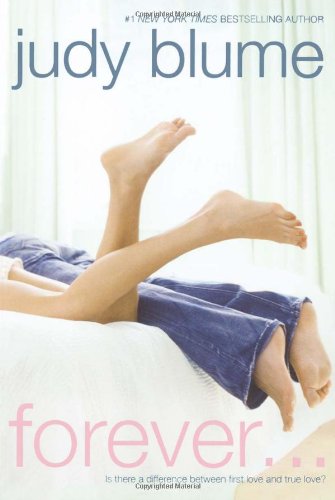
A Review: Forever...
 | ||
| Image from GoodReads.com |
Forever..., by Judy Blume
Summary:
Katherine is a senior in high school and when she meets Michael, he makes her feel really special. Together, they explore their sexuality together, moving as slowly as Katherine needs to feel comfortable. It's the first time Katherine or Michael has ever said "I love you," to anyone, and when they finally have sex for the first time, they just know that they will be together forever. But when summer comes and they both take summer jobs in different states, their forever will be tested.
Blume, J. (1975). Forever. New York, NY: Bradbury.
Impressions:
This book is frequently banned or challenged due to its unabashed look at a romantic young couple's first sexual experiences. The book doesn't hold anything back, and I can see why
A Review: Once I Ate a Pie
 | |
| Image from GoodReads.com |
Once I Ate Pie, by Patricia MacLachlan and Emily MacLachlan Charest
Illustrated by Katy Schneider
Awards:
ALA's Notable Books for Children Award Winner
Beehive Children's Poetry Book Award
Virginia's Readers' Choice Award (WOOT!)
Young Hoosier Book Award
Summary:
This book of poetry tells the story of 13 dogs from their own perspectives-- of their misbehavior, their loyalties, and what they really like to do all day. From the puppy on the first page who admits he's afraid of the big world for now, to Mr. Beefy, a giant pub who admits, "Once I ate a pie," and to the end, where the now grown up puppy (from the first poem), to Wupsi who loves how cute he is, to Abby, who chews everything in sight, and others in between, we finally end with Luke, who is actually the now-grown puppy from the first pages. This book of short poems is for dog lovers everywhere who can see a little bit of their pets in each of these lovable characters.
Machlachlan, P., & Charest, E.M. (2006). Once I ate a pie. New York, NY: Joanna Cotler Books.Impressions:
This book is a hilarious way to get inside a dog's head. Using wonderful imagery and a great use of diction and word arrangement, MacLachlan and her daughter bring to life 13 dogs, some mischievous, some good. The words on the page, especially the shape and size of the words, reflect the words themselves. For example, for Pocket's poem (a small dog who thinks he's BIG), the word "tiny" is shown in small text, and the last line, "I am HUGE" is written in large font. Abby, a dog who runs off with things--slippers, socks, meat off a plate, and anything in a bowl, has words displayed all over, in arcs across the page, with big and small text intermixed. This gives you the feeling of the mess Abby makes in her house. Aside from the beautiful words, Katy Schneider's beautiful illustrations are funny, expressive, and capture the dogs perfectly. They are a perfect match to the text, and the combination of all of these things make this book a real treat.
Tuesday, November 29, 2011
A Review: Rapunzel's Revenge
A Book Review of:
 |
| Image from GoodReads.com |
Rapunzel's Revenge, Shannon Hale and Dean Hale
Illustrated by Nathan Hale
It's a GRAPHIC NOVEL! Woo-hoo!
Awards: American Library Association Notable Books for Children AND Young Readers' Choice Award
Summary:
Rapunzel
was taken from her parents by Mother Gothel when she was a baby, and Rapunzel
has grown up thinking that Gothel is her real mom. She
lives inside a palace with giant walls surrounding it, and she’s not allowed to
see the other side. She finally sneaks to the other side and sees that
everything beyond the palace walls is dead—the land is completely barren. And she sees
thousands of workers from the mine lined up to get a drink of water. It turns
out that one of them is her real mother.
When she confronts Gothel about this, she is put into a prison cell at the top of a tall magical tree. She’s there for several years
and her hair grows long enough that she can finally use it as a rope to escape.
She meets an outlaw named Jack who agrees to help her get back to Mother
Gothel’s palace. Along
the way, Rapunzel (or Punzie as Jack likes to call her) figures out that she
can do a lot more than she can be a pretty good wrangler using her hair as a lasso,
and she wants to get vengeance on the woman who stole her from her mother,
imprisoned her, and made everyone’s lives in the kingdom miserable.
Hale, S. & Hale, D. (2008). Rapunzel's revenge. New York, NY: Bloomsbury.Impressions:
I love the Hales' take on this classic fairy tale. It's adventurous, fun, and transforms the Rapunzel from a quiet obedient woman waiting to be rescued in her high tower to a proactive girl with high hopes for rescuing her real mother and the rest of the kingdom from Mother Gothel's evil nature. It also makes Mother Gothel an even more villainous villain because she is a dictator witch ruling over the land which she controls because of her ability to make things grow or not grow. The budding feelings between Rapunzel and Jack (of Jack and the Beanstalk tales) also show how awkward they both can be about confronting their feelings, but this also stops their feelings from taking over the plot. The artistry of the novel is very eye-catching and compliments the text well, conveying emotions and certain actions without words. It's a great way to get reluctant readers reading. Because graphic novels are considered "cooler" than regular books by many children and teens, this lends a certain appeal. It is also appealing because it's a familiar story, but it clearly has Rapunzel as a heroine, which girls will enjoy reading about. But just because it's got a female lead doesn't mean this graphic novel won't appeal to boys either! After book talking this at our library, it was clear that it was a popular choice among all teens, and having won the Young Readers' Choice Award, I'd say this backs that up. Boys will like the amount of adventure and action in the book, and the funny parts as well as the girls will. It's a great read for everyone.
Professional Reviews:
"The popular author of Princess Academy teams with her husband and illustrator Hale (no relation) for a muscular retelling of the famously long-haired heroine's story, set in a fairy-tale version of the Wild West. The Hales' Rapunzel, the narrator, lives like royalty with witchy Mother Gothel, but defies orders, scaling villa walls to see what's outside--a shocking wasteland of earth-scarring mines and smoke-billowing towers. She recognizes a mine worker from a recurrent dream: it's her birth mother, from whom she was taken as punishment for her father's theft from Mother G.'s garden. Their brief reunion sets the plot in motion. Mother G. banishes Rapunzel to a forest treehouse, checking annually for repentance, which never comes. Rapunzel uses her brick-red braids first to escape, then like Indiana Jones with his whip, to knock out the villains whom she and her new sidekick, Jack (of Beanstalk fame), encounter as they navigate hostile territory to free Rapunzel's mom from peril. Illustrator Hale's detailed, candy-colored artwork demands close viewing, as it carries the action--Rapunzel's many scrapes are nearly wordless. With its can-do heroine, witty dialogue and romantic ending, this graphic novel has something for nearly everybody."
[Review of the book Rapunzel's revenge, by S. Hale & D. Hale]. (2008, August 4). Publisher's Weekly. Retrieved from http://www.publishersweekly.com
"This version of the classic fairy tale Rapunzel is set in the old Southwest, complete with cowboys, coal mines, and coyotes. Rapunzel is a young girl living in a fortress with Mother Gothel, an enchantress who can make plants grow at her whim. Although their home is overflowing with fruits and flowers, it is surrounded by a wall that masks the desert and coal mines outside-Gothel owns everything, and the native people depend on her good will to keep their crops growing. When Rapunzel sneaks over the wall on her twelfth birthday, she sees the desolate world over which Mother Gothel rules, and she meets her real mother who was forced to give Rapunzel to Gothel at birth. To punish her curiosity, Gothel imprisons Rapunzel inside an enchanted tree that has only one window, far above the ground. Just as in the original version, Rapunzel's hair grows prodigiously. But this girl does not need a prince to climb up and rescue her. She uses her braid as a lasso to escape the tree and goes on many adventures that lead her ultimately to reunite with her mother and find true love in a boy named Jack, whose companion is an uncooperative goose. The Hale team creates an engaging heroine. Rapunzel gallivants across the unexpected setting, meets a cast of characters both humorous and threatening, and in the end comes to inherit the land that Gothel had stripped of life and returns it to the native people. This novel presents entertaining girl power at its quirkiest."
Lehner, L. (2008, October 1). [Review of the book Rapunzel's revenge, by S. Hale & D. Hale]. Voice of Youth Advocates. Retrieved from http://www.voya.com/
Other Uses:
Writing workshops are a great way for kids and teens to show off their talents and become interested in different types of literature. Why not doing a graphic novel writing workshop? Show off some interesting graphic novels that have become popular lately, such as Rapunzel's Revenge, and then have them brainstorm and create the hero or heroine of their own story.
Then show them how they can create their own drawings, or they can pair up in the workshop with someone to create a graphic novel. The workshop can be only one session, or it can be multiple sessions (this would be more effective). At the end of the workshop, provide instructions for them to complete the project, or see them through to the end, and have them present their handmade graphic novels for the group to see.
Sunday, November 27, 2011
A Review: Phineas Gage: A Gruesome But True Story About Brain Science
 | |
| Image from Goodreads.com |
Phineas Gage: A Gruesome But True Story About Brain Science, by John Fleischman
Summary:
This non-fiction book for children and young adults gives an interesting look at how one man's accident in1848 that sent an iron rod through his brain left him alive, but completely altered in personality. This is Phineas Gage, a man who worked as a foreman in railroad construction until the accident made him lash out in angry bursts, unable to concentrate on tasks, and basically turned him into a different person. Part description of this incredible accident and part look at how this came to be a huge breakthrough in what doctors and neuroscientists understand about the working of the human brain, readers will enjoy the shock and awe of Phineas' incredible story, as well as learning about medical conditions and practices in the mid-19th century and how the brain works.
Fleischman, J. (2002). Phineas Gage. Boston, MA: Houghton Mifflin.Impressions:
After learning about Phineas Gage in introductory psychology classes at William and Mary, when I saw this on my class reading list, I jumped at the chance to learn more. The book tells Phineas' story in the present active voice from the first sentence, "The most unlucky/lucky moment in the life of Phineas Gage is only a minute or two away," (Fleischman, 2002, p. 1). It gives readers the feel of how the accident went down, and it's truly one of those stories that, although somewhat horrific, is interesting in only the way that terrible accidents can be-- like watching a car accident. But it's not painted in an overly graphic way. Instead, the tone is scientific, and gives great background of the medical practices at the time, as well as information on different kinds of brain injuries, and a history of how doctors learned about the presence of cells and bacteria. After Phineas Gage's obvious wounds were patched, he began acting in a way completely unlike his old self. He was rude, indecisive, crass, foul-mouthed, and angry. He lost his ability to interact socially. He ended up dying 11 years later from seizures that were probably another consequence of his brain injury from long ago. This remarkable story is not one to miss for any one-- children to adult-- who want to hear an incredible story of a man's accident and understand how the brain works. Alternating text with photographs and diagrams of the brain, this book makes non-fiction engaging and interesting. Complete with a glossary of terms, a list of resources for further reading, and a detailed index, this would be a great book for casual reading or for research.
Professional Reviews:
"Gr. 7-10. Railroad foreman and blasting expert Phineas Gage was hard at work in 1848 when an improperly prepared charge of gunpowder rocketed a three-foot-long iron rod through his brain. Bloodied and blackened, Gage remained coherent and surprisingly relaxed as he rode an oxcart back to town to get help. He survived the accident for nearly a dozen years, though his personality changed drastically: the once amiable man became crude and argumentative. The author combines this believe-it-or-not story with a history of brain research, including everything from phrenology to high-tech tools. The text is vivid, though curiosity seekers drawn in by the promise of a gruesome story will get bogged down in heavier sections on brain physiology and chemistry. The illustrations are well captioned but don't have enough visual interest to attract browsers for more than a moment. Report writers and science buffs will be the book's best audience. A glossary and an annotated bibliography help make this a terrific resource."
Meyer, R. (2002, March 1). [Review of the book Phineas Gage, by J. Fleischman]. Booklist. Retrieved from http://www.booklistonline.com/"The fascinating story of the construction foreman who survived for 10 years after a 13-pound iron rod shot through his brain. Fleischman relates Gage's "horrible accident" and the subsequent events in the present tense, giving immediacy to the text. He avoids sensationalizing by letting the events themselves carry the impact. The straightforward description of Gage calmly chatting on a porch 30 minutes after the accident, for example, comes across as horrifying and amazing. The author presents scientific background in a conversational style and jumps enthusiastically into such related topics as phrenology, 19th-century medical practices, and the history of microbiology. He shows how Gage's misfortune actually played an intriguing and important role in the development of our knowledge of the brain. The present-tense narrative may cause occasional confusion, since it spans several time periods and dates are not always immediately apparent from the text. Illustrations include historical photographs; one showing the iron bar posed dramatically next to Gage's skull is particularly impressive. Other photos and diagrams help explain the workings of the brain. The work of Gage expert Malcolm Macmillan, cited in the list of resources, seems the likely main source for the quotes and details of Gage's life, but this is not clearly spelled out in the text or appendixes. Like Penny Colman's Corpses, Coffins, and Crypts (Holt, 1997) and James M. Deem's Bodies from the Bog (Houghton, 1998), Phineas Gage brings a scientific viewpoint to a topic that will be delightfully gruesome to many readers."
Englefried, Steven. (2002, March 1). [Review of the book Phineas Gage, by J. Fleischman]. School Library Journal. Retrieved from http://www.schoollibraryjournal.com/
Other Uses:
Use this book in a book talk to introduce older children and teens to nonfiction books that might interest them. In this book talk, I would center my books around books that revolve around science, but also the horrific, because these tend to hook reluctant readers. Here are several options of other books to include in such a book talk. Book with pictures and diagrams are often good choices here because reluctant readers can sometimes be overwhelmed by text.
- Phineas Gage: A Gruesome but True Story About Brain Science, by John Fleischman
- Bury the Dead: Tombs, Corpses, Mummies, Skeletons, & Rituals, by Christopher Sloan
- Read my review of this book here-- This book discusses burial practices as uncovered by archaeologists in this book published by the National Geographic Society.
- Bodies from the Ash, by James Deem
- About the bodies in Pompeii and Herculaneum that were recovered from the ashes of Mt. Vesuvius' AD 79 eruption.
- Bodies from the Bog, by James Deem
- About bodies that have been recovered from bogs in Northern Europe.
- Science Fair Season: Twelve Kids, a Robot Named Scorch, and What It Takes to Win, by Judy Dutton
- An international science fair that shows that science fair projects can go WAY beyond growing plants in different kinds of water.
A Review: Bury the Dead
 | |
| Image from Goodreads.com |
Bury the Dead: Tombs, Corpses, Mummies, Skeletons, & Rituals, by Christopher Sloan
Foreward by Dr. Bruno Frohlich
Summary:
This non-fiction book for children and young adults describes different burial practices from past cultures up to today's practices for burying the dead. The burial practices covered include prehistoric burials, mummification in Egypt, golden tombs of the Amazons, the thousands of clay soldiers found in a Chinese emperor's tomb, tombs of the Moche lords of Peru, and a modern look at how we bury the dead in our own societies and how they might affect how people view us in the future. This book will satisfy morbid curiosities about ancient burials as well as teach a little anthropology and archaeology to show what scientists make of these remains and how anthropologists interpret them.
Sloan, C. (2002). Bury the dead. Washington, DC: National Geographic Society.Impressions:
Taking a topic and a book cover that will draw in lots of inquisitive minds, this National Geographic book by Christopher Sloan does a great job of introducing different burial practices throughout history to children and young adults. The language is not dumbed or watered down for children. It defines concepts throughout and provides a glossary at the back for easy reference, but also challenges kids to use their minds. With brilliant photographs of real burial practices, as well as imagined drawings of ancient burial rituals, it gives kids a view of the past, and translating that to how anthropologists study the past through scientific techniques in the present.
For kids who are naturally curious about morbid things like all of the things listed on the cover of this book-- tombs, corpses, mummies, skeletons and rituals, it is an enticing book. It is also easy to use and understand. Each chapter features a case study of burial practices in a different part of the world. Organized from oldest to the present, day, it analyzes different practices in an unbiased way. In addition, the text isn't overwhelming, as it is broken up by great diagrams and photographs and some side bars. With the type of research you'd expect from a National Geographic book, readers and parents of readers can see that this book is supplied with expert knowledge from very specific fields. Included are a table of contents, an index, and a bibliography that can aid interested readers with further resources.
Professional Reviews:
"Gr. 5-9. Kids will find it hard to resist picking up a book with words like corpses and skeletons in the title. And this one doesn't disappoint. Sloan, an editor at National Geographic magazine and the author of two previous books for children, does a terrific job of providing an intriguing, reader-friendly text that is not overshadowed by the fabulous color photographs from the National Geographic Society's archives. These pictures do not shirk from their subject: a full-page photo of a Peruvian mummy staring out from his burial cloth, his knees raised to his chest; a close-up of a "bog person" clearly showing, as the caption says, skin turned to leather by acidic conditions in the swamp. There are also many pictures of excavations, artifacts, and burial sites. Along with discussions of how and why people bury their dead are chapters on particular peoples and their traditions. There's material on the Egyptians, of course, but also on the Chinese, the terra-cotta soldiers of the Qin dynasty, and the Russian tombs of the Amazon women who lived between 800 and 100 B.C.E. Sloan had access to experts to vet his book, and it shows. This has the ring of authority and the look of quality."
Cooper, I. (2002, December 1). [Review of the book Bury the dead, by C. Sloan]. Booklist. Retrieved from http://www.booklistonline.com/
"Gr 5-9-An exceptionally handsome book on a macabre topic. The lucid text discusses the why of funeral rites and internment and then presents a vista of burials, beginning with the shadowy reaches of far prehistory through the colorful tombs of ancient Egypt, the golden graves of the Scytho-Siberians, the horde of clay warriors surrounding the tomb of the first Qin emperor, and the caparisoned grave of the Moche Lord of Sip ne Peru. The author closes with an investigation into more modern burial practices and speculates on what they may reflect about our relatively recent cultures, with a note on offending ethnic groups when ancient burial sites are disturbed for research. Formal in tone, the book includes location maps; a time line; colorful diagrams; realistic artwork; and an array of clear, color photos (some may find that the close-ups of mummies, fleshless skulls, and other mortal remains make them queasy). For those who have been fascinated with such dynamic titles as James M. Deem's Bodies from the Bog (Houghton, 1998), Donna M. Jackson's The Bone Detectives (Little, Brown, 1996), and Johan Reinhard's Discovering the Inca Ice Maiden (National Geographic, 1998), this title will prove irresistible."
Manning, P. (2002, October 1). [Review of the book Bury the dead, by C. Sloan]. School Library Journal. Retrieved from http://www.schoollibraryjournal.com/
Other Uses:
Around Halloween, have an educational program at the library for tweens and teens that discusses holidays that celebrate the dead such as All Saints Day, the Day of the Dead (Dia de los Muertos), and Halloween. Discuss what these holidays used to mean. Use this book to introduce different ways that people have buried their dead.
After a short talk about how people bury and celebrate their dead, do a craft project by making Day of the Dead masks. For a food component, introduce them to "Pan de Muertos" (bread in the shape of a skull and crossbones can be lots of fun!), offerings to the dead of "wine" (AKA grape juice) and bread. You could also take them through a "House of Horror" where they would have a blindfold on and be forced to feel brains! (spaghetti), eyeballs! (peeled grapes), ears! (dried apricots), and skin! (fruit roll ups).
Saturday, November 26, 2011
A Review: Al Capone Does My Shirts
Book Review of
Al Capone Does My Shirts, by Gennifer Choldenko
2005 Newbery Honor Book
New York Times Best Seller
Summary:
In 1935, twelve year old Moose and his family move to Alcatraz Island where his father has taken a job as an electrician. They have moved there to be closer to a special school for Moose's sister, Natalie, who has special needs. Moose is forced to get along with the children on the tiny prison island, including the warden's snotty daughter Piper, who is troublesome and used to getting her way. In addition, Moose is forced to take on the responsibility of caring for his sister every day after school and his mom and dad try to make ends meet working multiple jobs so that they can afford to send Natalie to a school they think may help her fit into society.
Although this book's setting is historic in time and place, it is not slow or bogged down with historic details which can turn some readers (especially young readers) off of historic literature. In addition, the setting-- on Alcatraz in the 1930s, with one of the most legendary criminals in recent American history-- is one that may draw in those reluctant to read historical fiction. Moose is a relate-able character who is forced to grow up too fast because of his sister's mental condition-- she is autistic, and in 1935 there are limited options for his sister Natalie. Although Natalie is actually older than he is (she's 15 but their mother tells everyone she is 10 because of the way she acts), Moose is forced to take care of her, which keeps him from playing baseball after school with friends, and prevents him from feeling like he fits in. He is constantly torn between wanting to be free of his responsibilities and wanting the best thing for Natalie, which ultimately wins out every time. Although this book has serious undertones, it remains humorous throughout, and is a fast and interesting read. Moose is a well-developed character, and the problems he faces-- balancing responsibility with a need for freedom and the ability to act as a kid, make him interesting and his situations realistic.
Professional Reviews:
"In 1935, notorious gangster Al Capone is one of three hundred convicts housed in the maximum-security penitentiary on Alcatraz Island. Twelve-year-old Moose Flanagan also lives on the island. His father has taken a position as an electrician and guard at the prison in hopes that Moose's sister, Natalie, will be accepted at a special school in nearby San Francisco. Not only has Moose been forced to leave friends behind and move with his family to a fortress island, but he also cannot play baseball or make new friends now because he is stuck taking care of his sister whenever he is not in school. Natalie is afflicted with the condition now known as autism, and even at age sixteen, she cannot be left unsupervised. Everyone in the family has been under a strain because of Natalie's special needs. Meanwhile Piper, the warden's pretty, spoiled daughter, makes life complicated for Moose. The island's residents have their laundry done by the convicts, and thrill-seeking Piper drags Moose into her wild stunt of marketing Al Capone's laundry services to their middle school classmates in San Francisco. But when his family desperately needs a break in their efforts to get help for Natalie, Moose knows that only Piper has the connections and the audacity to help him pull off a reckless scheme involving the island's most famous inmate. Choldenko, author of Notes from a Liar and Her Dog (Putnam's, 2001/VOYA August 2001), weaves three As-Alcatraz, Al Capone, and autism-into an excellent historical novel for middle-grade readers. A large, annotated 1935 photograph of Alcatraz Island and an informative author's note give substance to the novel's factual sources."
Other Uses:
In this book, Moose writes a letter to Al Capone asking him to help his sister get into the special school. Have young adults write a letter to an historical figure and have them relate it to something about that person. If you want to get really spiffy, have a letter exchange where one teen writes a letter to an historical figure, and another person must answer it.
 |
| Image from Goodreads.com |
Al Capone Does My Shirts, by Gennifer Choldenko
2005 Newbery Honor Book
New York Times Best Seller
Summary:
In 1935, twelve year old Moose and his family move to Alcatraz Island where his father has taken a job as an electrician. They have moved there to be closer to a special school for Moose's sister, Natalie, who has special needs. Moose is forced to get along with the children on the tiny prison island, including the warden's snotty daughter Piper, who is troublesome and used to getting her way. In addition, Moose is forced to take on the responsibility of caring for his sister every day after school and his mom and dad try to make ends meet working multiple jobs so that they can afford to send Natalie to a school they think may help her fit into society.
Choldenko, G. (2004). Al Capone does my shirts. New York, NY: G.P. Putnam's Sons.Impressions:
Although this book's setting is historic in time and place, it is not slow or bogged down with historic details which can turn some readers (especially young readers) off of historic literature. In addition, the setting-- on Alcatraz in the 1930s, with one of the most legendary criminals in recent American history-- is one that may draw in those reluctant to read historical fiction. Moose is a relate-able character who is forced to grow up too fast because of his sister's mental condition-- she is autistic, and in 1935 there are limited options for his sister Natalie. Although Natalie is actually older than he is (she's 15 but their mother tells everyone she is 10 because of the way she acts), Moose is forced to take care of her, which keeps him from playing baseball after school with friends, and prevents him from feeling like he fits in. He is constantly torn between wanting to be free of his responsibilities and wanting the best thing for Natalie, which ultimately wins out every time. Although this book has serious undertones, it remains humorous throughout, and is a fast and interesting read. Moose is a well-developed character, and the problems he faces-- balancing responsibility with a need for freedom and the ability to act as a kid, make him interesting and his situations realistic.
Professional Reviews:
"In 1935, notorious gangster Al Capone is one of three hundred convicts housed in the maximum-security penitentiary on Alcatraz Island. Twelve-year-old Moose Flanagan also lives on the island. His father has taken a position as an electrician and guard at the prison in hopes that Moose's sister, Natalie, will be accepted at a special school in nearby San Francisco. Not only has Moose been forced to leave friends behind and move with his family to a fortress island, but he also cannot play baseball or make new friends now because he is stuck taking care of his sister whenever he is not in school. Natalie is afflicted with the condition now known as autism, and even at age sixteen, she cannot be left unsupervised. Everyone in the family has been under a strain because of Natalie's special needs. Meanwhile Piper, the warden's pretty, spoiled daughter, makes life complicated for Moose. The island's residents have their laundry done by the convicts, and thrill-seeking Piper drags Moose into her wild stunt of marketing Al Capone's laundry services to their middle school classmates in San Francisco. But when his family desperately needs a break in their efforts to get help for Natalie, Moose knows that only Piper has the connections and the audacity to help him pull off a reckless scheme involving the island's most famous inmate. Choldenko, author of Notes from a Liar and Her Dog (Putnam's, 2001/VOYA August 2001), weaves three As-Alcatraz, Al Capone, and autism-into an excellent historical novel for middle-grade readers. A large, annotated 1935 photograph of Alcatraz Island and an informative author's note give substance to the novel's factual sources."
Hogan, W. (2004, April 1). [Review of the book Al Capone does my shirts, by G. Choldenko]. Voices of Youth Advocacy Reviews. Retrieved from http://www.voya.com/"Moose’s world is turned upside down when his family moves to Alcatraz Island where his Dad has taken a job as a prison guard. Super-responsible Moose, big for 12, finds himself caught in the social interactions of this odd cut-off world. He cares for his sister who is older, yet acts much younger due to her autism and he finds his life alternating between frustration and growth. His mother focuses all of her attention on ways to cure the sister; his dad works two jobs and meekly accepts the mother’s choices; his fellow island-dwellers are a funny mix of oddball characters and good friends. Basing her story on the actual experience of those who supported the prison in the ’30s—when Al Capone was an inmate—Choldenko’s pacing is exquisite, balancing the tense family dynamics alongside the often-humorous and riveting school story of peer pressure and friendship. Fascinating setting as a metaphor for Moose’s own imprisonment and enabling some hysterically funny scenes, but a great read no matter where it takes place. (lengthy author’s note with footnotes to sources) (Fiction. 11-14)."
[Review of the book Al Capone does my shirts, by G. Choldenko]. (2004, March 1). Kirkus' Reviews. Retrieved from http://www.kirkusreviews.com
Other Uses:
In this book, Moose writes a letter to Al Capone asking him to help his sister get into the special school. Have young adults write a letter to an historical figure and have them relate it to something about that person. If you want to get really spiffy, have a letter exchange where one teen writes a letter to an historical figure, and another person must answer it.
Subscribe to:
Posts (Atom)